
Litchfield County Court Dockets
A court docket is the running case log. For Litchfield County court dockets, the docket number, case caption, court location, filing entries, hearing events, orders, continuances, dispositions, and sentencing or judgment entries can appear depending on the case type. The docket helps a reader see what has happened and what may be scheduled next. It does not always show the full text of each pleading, exhibit, affidavit, police narrative, financial document, or certified order.
Connecticut's structure changes how Litchfield County court dockets are found. There is no county court docket or justice-of-the-peace court docket. Most ordinary trial-level case activity is in Superior Court. Probate dockets are in Probate Court systems. Police arrest reports are held by police agencies, while criminal court dockets are held by the Judicial Branch after a case enters court. That split keeps the docket search useful, but it also means the docket is only one part of the record trail.
- Docket number
- The unique court case identifier used for searches and copy requests.
- Docket entry
- A line on the case timeline, such as a motion, order, appearance, continuance, plea, or judgment.
- Disposition
- The outcome of a case or charge, such as judgment, dismissal, conviction, acquittal, or nolle.
- Short calendar
- A Connecticut civil or family calendar for motions and shorter court matters.
Find Litchfield County Court Dockets
The search route depends on the docket type. Civil, family, housing, small claims, short calendar, and civil event dockets are searched through civilinquiry.jud.ct.gov. Pending criminal and motor-vehicle dockets are searched through the Judicial Branch CRDockets system. Conviction searches use a separate CRDockets route, and docket-number routes exist for both pending and disposed criminal or motor-vehicle cases.
- Select the case type first: civil/family, criminal/motor vehicle pending, criminal/motor vehicle conviction, or probate.
- Use a docket-number search when the docket number is known because it gives the most precise result.
- Use party-name or defendant-name search when the docket number is unknown, then narrow by Litchfield Judicial District or Torrington Geographical Area 18.
- Open the public result and compare the court location, category, parties, and event dates before relying on the record.
- Call the clerk at the court location shown on the docket for certified copies or entries not visible online.
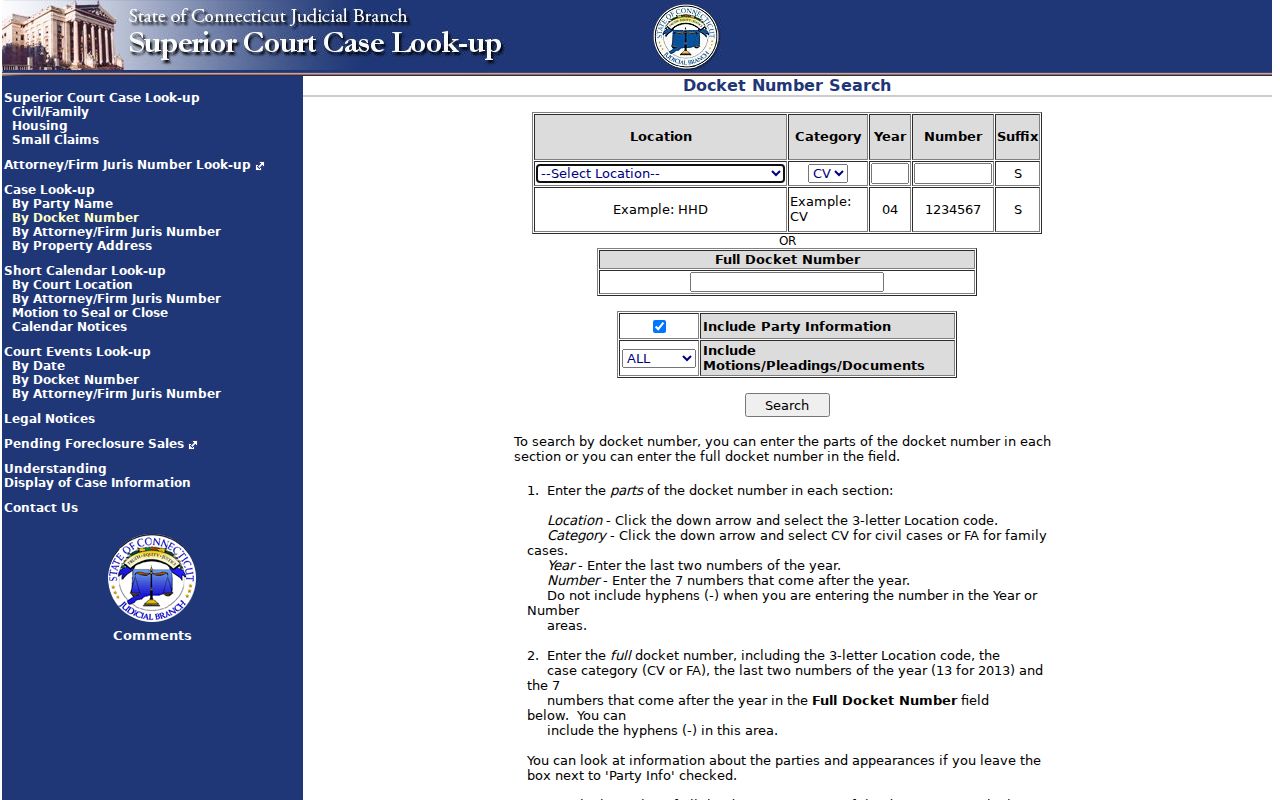
The civil docket-number search page is the exact route to use when a Litchfield County civil or family docket number is already known.
Litchfield County Docket Entries
A Litchfield County court docket entry should be read as a case event, not as a full document. If the docket says a motion was filed, the entry may identify the filing date and title without making the motion itself available online. If a court event is listed, the entry may provide a date, court location, or session, but parties should confirm current scheduling through the official system or clerk because court dates can change.
| Field | What It Shows |
|---|---|
| Docket Number | The case identifier needed for later searches, clerk calls, and copy requests. |
| Entry Date | The date a filing, order, notice, hearing, plea, disposition, or other event was entered. |
| Event Type | The general action, such as appearance, motion, order, hearing, judgment, sentencing, or continuance. |
| Party or Attorney | The party, attorney, or state actor tied to a filing when the public display includes it. |
| Court Location | The Superior Court location, such as Litchfield Judicial District or Torrington Geographical Area 18. |
| Disposition | The result of a claim, case, or criminal charge when the case has reached an outcome. |
| Document Access | Whether a public document is linked, unavailable online, sealed, erased, or obtainable only through the clerk. |
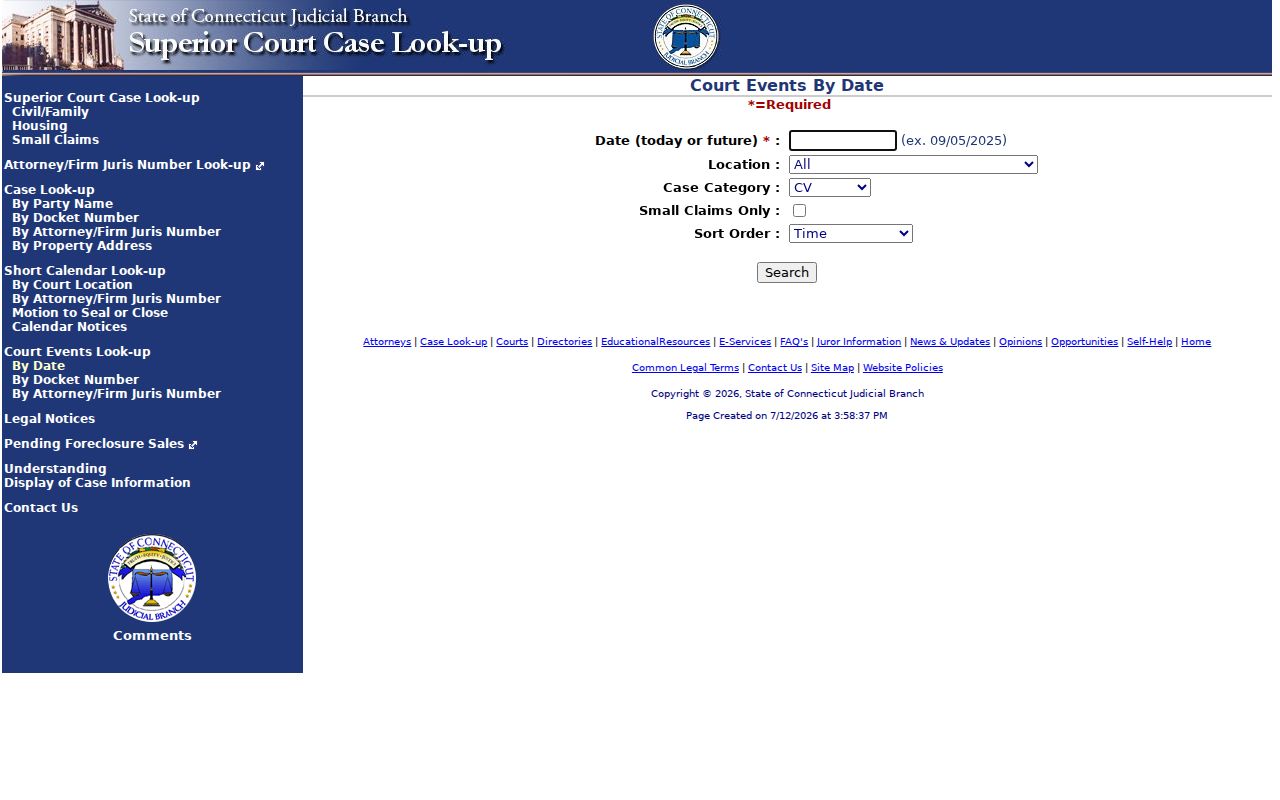
The court events by date search is useful when the goal is a scheduled civil or family event rather than a full docket history.
Litchfield County Docket Sources
Litchfield County court dockets are tied to Connecticut courts and state systems. The Superior Court is the main docket source for local civil, criminal, family, housing, small claims, and motor-vehicle cases. The Probate Court has separate filing and access tools. Appeals from Superior Court generally move to the Appellate Court and sometimes the Supreme Court, so an appeal may create a new appellate docket even though the trial record began in Litchfield Judicial District.
The Litchfield Judicial District courthouse in Torrington is the practical anchor for many local docket questions. Civil lawsuits, family matters, divorce cases, foreclosures, serious criminal cases, and related judicial-district filings point to the Superior Court docket. GA 18 is the important label for many criminal and motor-vehicle matters. Probate dockets are separate because estates, trusts, conservatorships, guardianships, and certain children's matters use Connecticut Probate Court districts rather than the Superior Court civil inquiry page.
- Litchfield Judicial District Superior Court handles many local civil, family, divorce, serious criminal, and judicial-district matters.
- Torrington Geographical Area 18 appears in criminal and motor-vehicle docket searches for GA matters.
- Probate Court districts handle estates, trusts, conservatorships, guardianships, name changes, and probate jurisdiction.
- The Appellate Court and Supreme Court handle appeals rather than initial trial docket filings.
- Municipal police departments create arrest and incident records, but they are not court docket custodians.
Note: Litchfield County has no county court, county clerk docket, county sheriff docket, or JP court docket.
Litchfield County Criminal Dockets
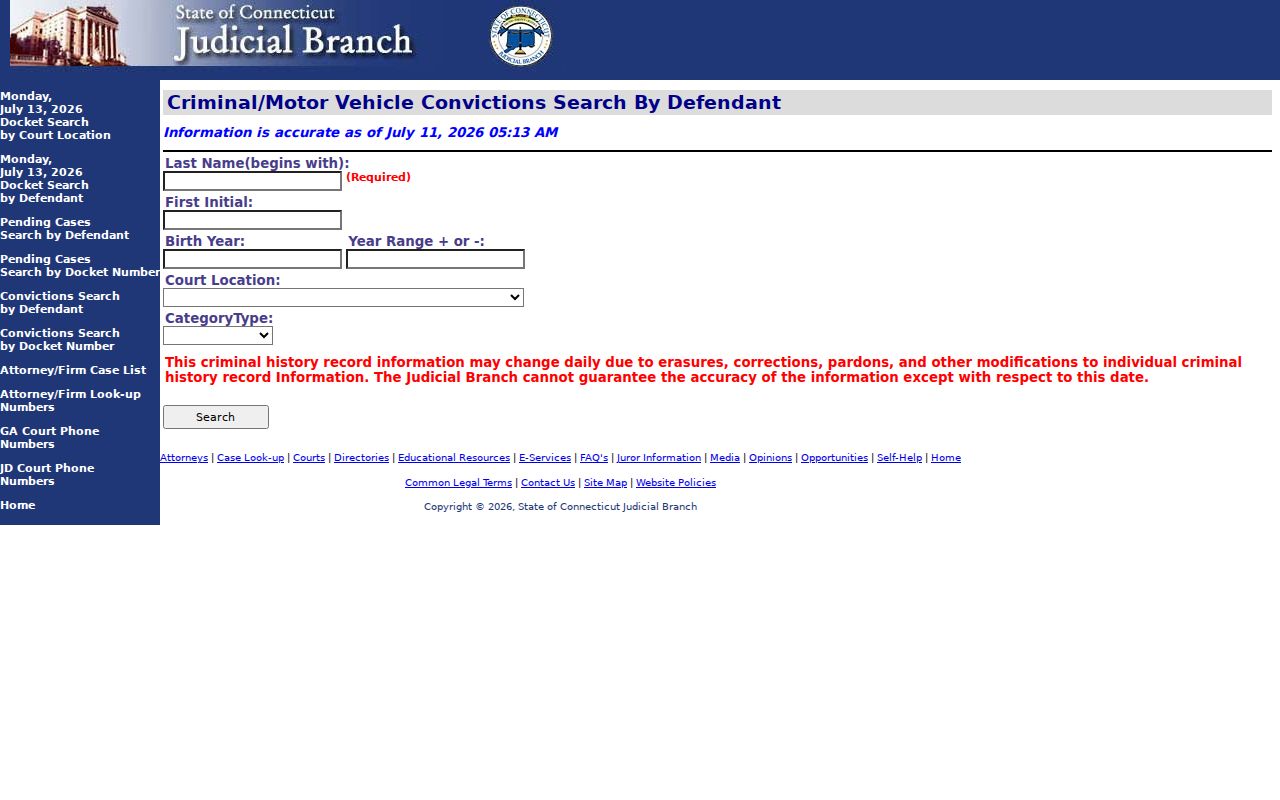
Criminal and motor-vehicle dockets use the Judicial Branch CRDockets system. The pending defendant search asks for last name, optional first initial, birth year, year range, court location, and category type. The court-location dropdown includes Litchfield Judicial District and Torrington Geographical Area 18. A pending result should be checked against the court location and category because one person can have more than one docket or more than one charge.
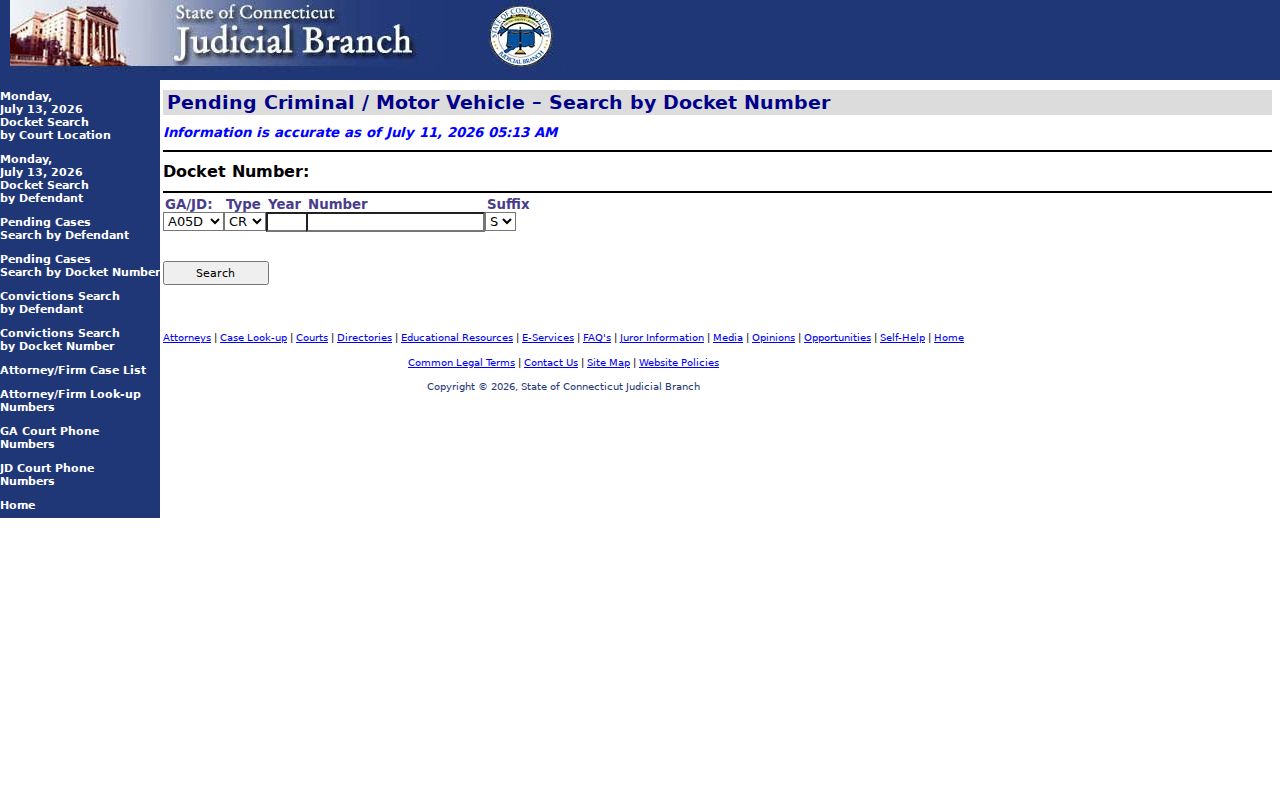
The pending criminal docket-number search works when the docket number is known.
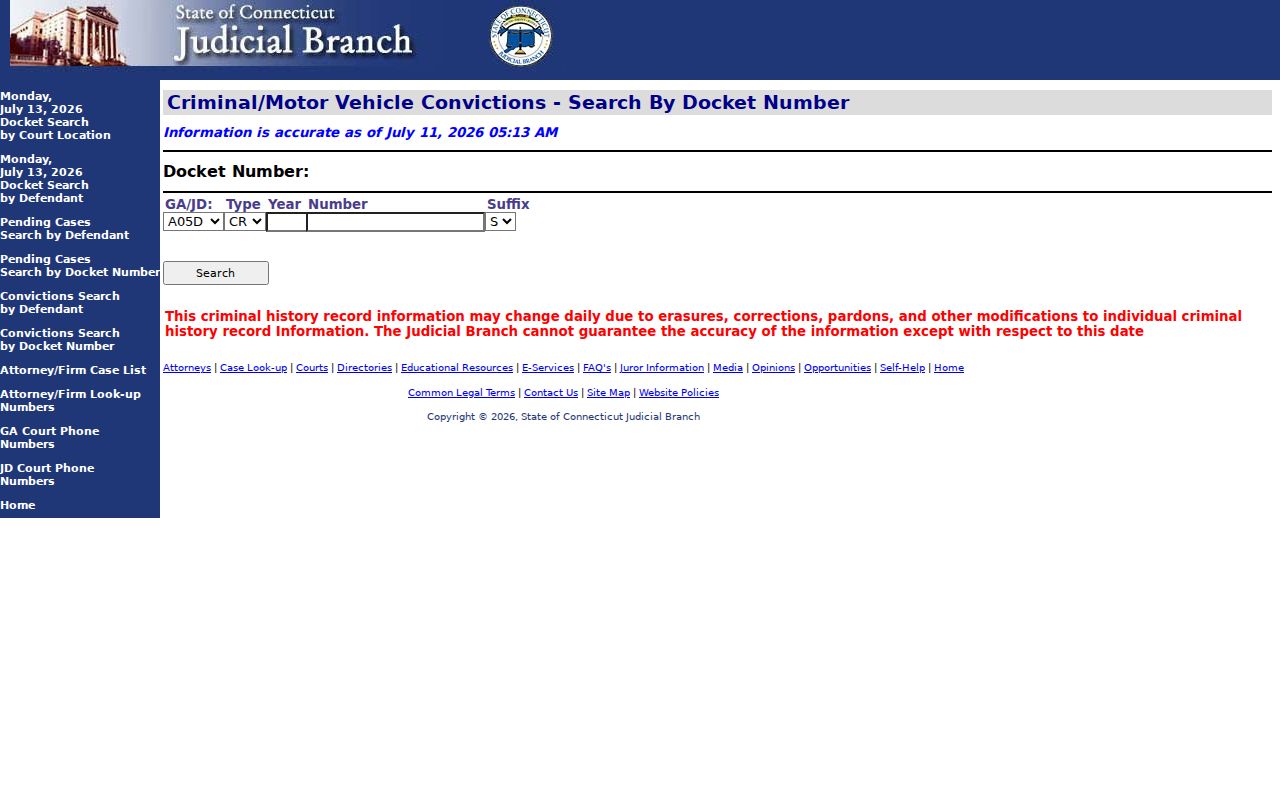
The disposed criminal docket-number search is the companion route for conviction or disposed-case docket numbers.
Litchfield County Dockets vs Records
A docket is a map of the case. The full court record is broader. For Litchfield County court dockets, the public display may show that a complaint, motion, order, plea, judgment, or sentencing event occurred. The full case record may include pleadings, exhibits, affidavits, orders, financial filings, transcripts, and sealed or redacted material. For a broader file overview, use the main Litchfield County court records page.
The distinction matters most when a person needs proof. A docket entry that says judgment entered may be enough to learn case status, but a certified judgment is a clerk-issued copy. A docket entry that says a divorce was granted can identify the court and case, but the divorce decree must come from the Superior Court that granted it. A docket entry that shows a charge was dismissed can help locate the result, but the certified criminal disposition is still a court copy issue.
| Point | Docket | Full Case Record |
|---|---|---|
| Format | Chronological list of case events. | Case file with docket plus documents, orders, and filings. |
| Access | Often searchable online for public case types. | May require clerk contact, file review, copy fees, or court permission. |
| Best Use | Track status, dates, location, and outcome. | Read filed documents, certified decrees, orders, or complete case history. |
| Limits | May omit restricted documents or full text. | May include sealed, redacted, confidential, or nonpublic sections. |
Read Litchfield County Court Dockets
Start with the docket number, court location, and case category. Those fields tell where the case sits and which clerk should be contacted. Next, read dates in order. A civil docket may show appearances, motions, orders, short-calendar events, judgment, and post-judgment enforcement. A criminal docket may show arraignment, bond, pleas, motions, continuances, disposition, sentence, probation, violation proceedings, or erasure-related changes.
Charges and convictions must be separated. A pending charge is an accusation filed in court. A conviction is an outcome by plea or verdict. The criminal/motor-vehicle conviction search has a daily accuracy timestamp and warns that criminal history information may change due to erasures, corrections, pardons, and other modifications.
When a docket entry is unclear, use plain terms. An appearance identifies representation. A motion asks the judge to order something. A continuance postpones an event. A nolle is a prosecutor's decision not to proceed at that time, and it can later matter for Connecticut erasure rules.
For in-person or phone follow-up, keep the docket number, party name, approximate filing year, and court location together. The clerk can use those details to distinguish a Litchfield Judicial District civil docket from a Torrington GA 18 criminal or motor-vehicle docket. If the case is restricted, sealed, juvenile, erased, or not yet updated online, the clerk can identify the available access route without turning the public index into a full file copy.