
Litchfield County Criminal Court Records
A criminal court record is broader than the charge list. It is the court file and docket history that begins once a prosecutor files or pursues charges in Superior Court. It may include the charging document, docket number, court location, bond conditions, arraignment events, pleas, motions, continuances, disposition, sentence, probation, violation proceedings, and later erasure or sealing status. The clerk, not the police department, is the key source for certified court copies.
Litchfield County criminal matters are part of Connecticut Superior Court. Serious criminal work routes through the Litchfield Judicial District courthouse in Torrington, while many criminal and motor-vehicle matters use the Torrington Geographical Area 18 label in CRDockets. The official Litchfield Judicial District State's Attorney page identifies David R. Shannon as State's Attorney and places the prosecution office at the Torrington courthouse.
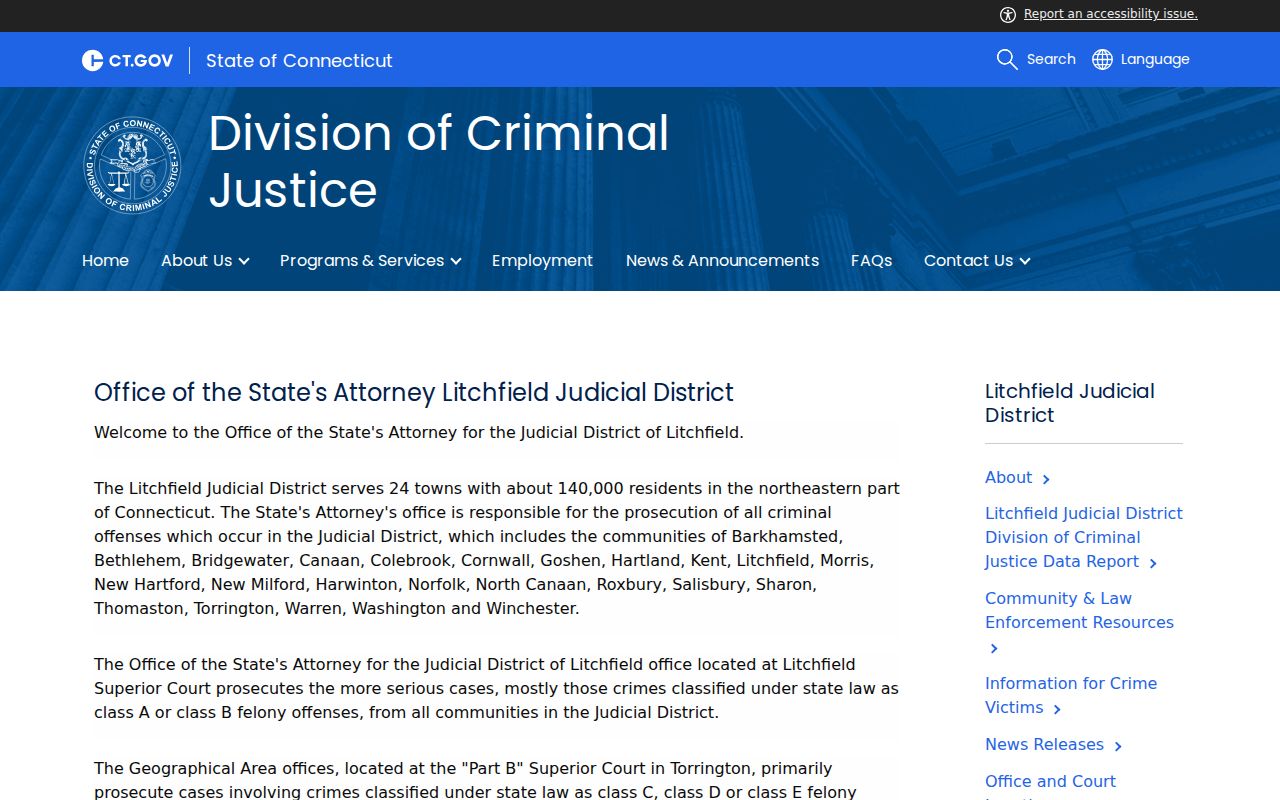
The prosecutor's office explains who brings the criminal case, while the court docket explains what has happened in court.
For copy requests, the docket number is the strongest identifier. It lets the clerk distinguish a criminal case from a motor-vehicle matter, a pending case from a conviction record, and a public file from a restricted or erased record.
Find Litchfield County Criminal Records
Use the Judicial Branch CRDockets system for pending criminal and motor-vehicle cases and for convictions. The defendant search uses last name, first initial, birth year, year range, court location, and category type. The docket-number route is best when court paperwork already gives a docket. For Litchfield County searches, the important court-location filters are Litchfield Judicial District and Torrington Geographical Area 18.
Name searches need care because the public form can return close matches. Use first initial, birth year, category type, and court location to separate similar names. Pending case search and conviction search should also stay separate. A pending charge is an accusation that has not reached a final outcome. A conviction result is outcome-focused, but it still may change after erasure, pardon, correction, or later court action.
- Choose pending criminal, conviction, defendant, or docket-number search based on the record needed.
- Enter at least the defendant's last name for a defendant search, then narrow by first initial or birth year when possible.
- Select Litchfield Judicial District or Torrington GA 18 if the case is tied to local court activity.
- Open the result and record docket number, court location, charge status, and next court event.
- Contact the Clerk of the Superior Court for certified copies or documents not displayed online.
| Field label | Type | Required | Notes |
|---|---|---|---|
| Last Name begins with | Text | Yes for defendant search | Searches from the first letters entered. |
| First Initial | Text | No | One character can narrow common names. |
| Birth Year | Text | No | Four-digit year if known. |
| Court Location | Dropdown | No | Includes Litchfield JD and Torrington GA 18. |
| CategoryType | Dropdown | No | Blank, Criminal, or Motor Vehicle. |
| Docket Number | Text | Yes for docket route | Best route for an exact known case. |
Litchfield County Criminal Case Flow
A criminal court record changes as the case moves. An arrest or summons may lead to a court docket, but the formal court file tracks the charges filed, court dates, bond, plea events, motion practice, disposition, and sentence. A pending case can later show reduced charges, dismissed counts, nolle prosequi entries, acquittal, conviction, probation, violation of probation, or erasure.
The docket can also show events after the original sentence. Probation violations, failure-to-appear events, bond changes, and post-judgment motions may create later entries. Those later entries matter because a person reading only the first charge line may miss the final result. Always match a charge to its disposition and match a sentence to the count that produced it.
Case flow: Charges Filed › Arraignment › Pretrial › Plea or Trial › Disposition › Sentencing › Probation or Appeal.
| Stage | What the record may show |
|---|---|
| Charges filed | Offense title, statute, court location, docket number, and offense date. |
| Arraignment | Plea, bond, release conditions, counsel status, and next date. |
| Pretrial and motions | Continuances, motions, hearings, discovery events, and orders. |
| Plea or trial | Guilty plea, not guilty finding, trial events, verdict, or dismissal. |
| Disposition and sentence | Conviction, nolle, dismissal, fine, jail, probation, restitution, or other sentence terms. |
Litchfield County Criminal Record Fields
The public result is not a certified criminal-history report. It is a court record display that may change daily due to corrections, erasures, pardons, modifications, and later case action. A result should be read as court information from the Judicial Branch, then verified with the court location when a certified copy or formal proof is needed.
Police and custody records are separate. A municipal police department or Connecticut State Police troop may hold the arrest report or incident narrative. The Connecticut Department of Correction holds current state custody data when a person is committed pretrial or sentenced. The Superior Court criminal record shows the court case, not every fact collected by police or every custody movement made by DOC.
| Field | What it shows |
|---|---|
| Docket number | The court's exact criminal or motor-vehicle case identifier. |
| Defendant | Name and public identifiers available in the court system. |
| Court location | Litchfield JD, Torrington GA 18, or another Connecticut venue. |
| Charges | Offense titles, statute references, and charge status where public. |
| Plea | How the defendant answered a charge when that event is public. |
| Disposition | Conviction, dismissal, nolle, acquittal, or other result. |
| Sentence | Fine, jail, probation, restitution, or other sentencing terms when shown. |
Litchfield County Charges vs Convictions
A charge is an accusation filed in court. A conviction is a result after a guilty plea, verdict, or other final criminal outcome. A criminal court record may show charges that were dismissed, dropped, reduced, nolled, or ended in acquittal. That distinction is critical for background checks, employment, licensing, and personal review.
For high-stakes use, the safest record is a certified disposition or certified copy from the court. Public search results are helpful for locating the docket, but a formal record request should identify the exact docket number, court location, defendant name, and charge or disposition needed. This is especially important when multiple counts resolve in different ways.
| Charge | Conviction | |
|---|---|---|
| Meaning | Alleged offense filed in court. | Final finding or plea resulting in guilt. |
| Can change? | Yes, charges can be amended, reduced, nolled, or dismissed. | Yes, later relief, appeal, pardon, or erasure can affect display. |
| Where searched | Pending CRDockets and docket-number routes. | Conviction search and certified court records. |
Litchfield County Prosecution and Defense
Connecticut prosecutors are State's Attorneys. The Litchfield State's Attorney handles prosecution for the Judicial District of Litchfield, including serious Part A matters at the Torrington courthouse. The State's Attorney page lists David R. Shannon and the Field Street office with phone, fax, and state email. Prosecutor records are not a substitute for a court docket, but they explain who files and pursues charges.
The Torrington Judicial District Public Defender page lists Public Defender Services at 50 Field Street, Suite 207.
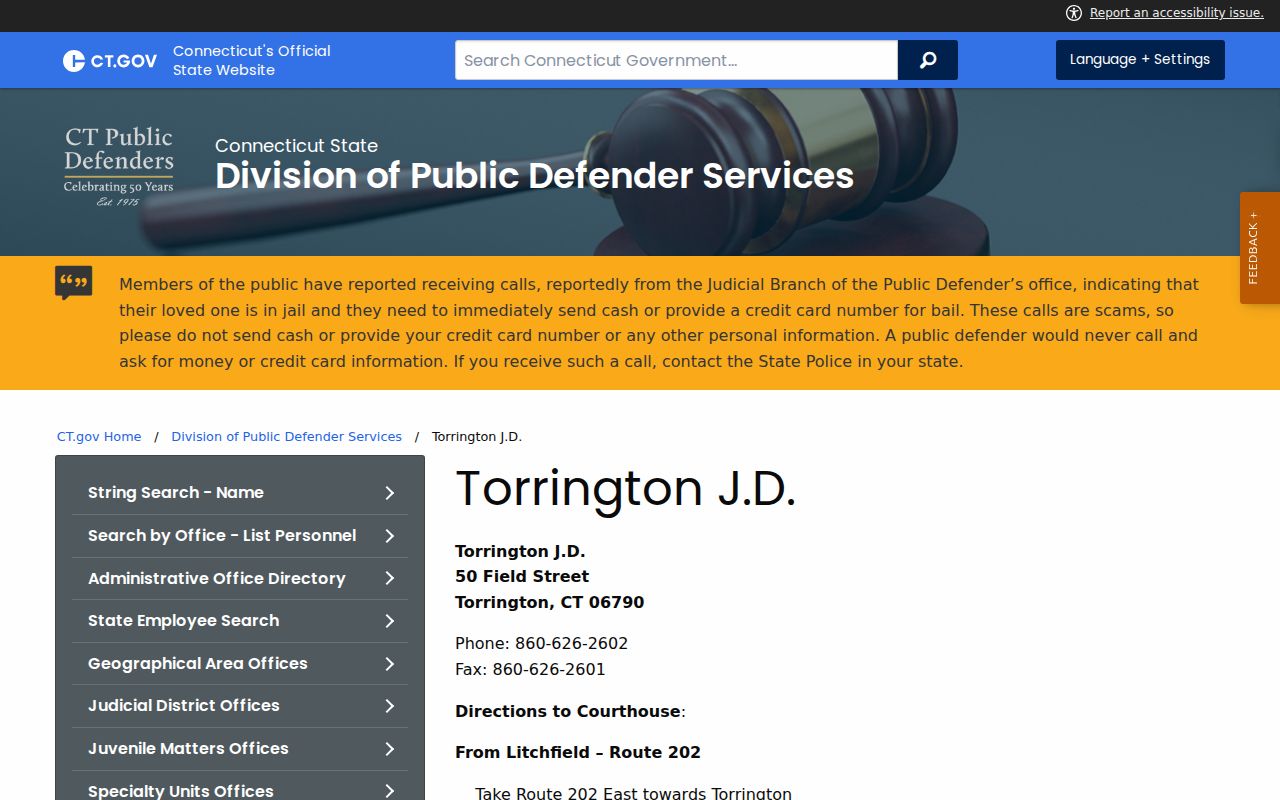
Public defender representation depends on eligibility and court appointment, so the office should not be used as a general court-record counter.
Restricted Litchfield County Criminal Records
Public access is limited by juvenile confidentiality, erasure, sealing, protected personal identifiers, victim privacy, and court orders. Connecticut uses the term erasure for many criminal-record-clearing situations. Public records may disappear or change after a qualifying dismissal, acquittal, nolle period, pardon, or Clean Slate event. Sealing is different because it restricts access by court order rather than treating the record as erased.
Connecticut FOIA can help with public agency records, but court files are handled through Judicial Branch rules and clerk procedures. A police report request, DOC custody search, and Superior Court criminal docket request can all relate to the same arrest, yet each one has a different custodian and access rule. If the court result is missing or incomplete, the reason may be erasure, sealing, juvenile status, timing, or use of the wrong system.
| Erased | Sealed | |
|---|---|---|
| Source | Connecticut criminal-record erasure statutes. | Court order or rule-based restriction. |
| Effect | Public disclosure is limited and portal display may change. | Document or file access is restricted. |
| Next step | Ask the clerk about the erasure or correction process. | Review court order or ask about access procedure. |
Note: Juvenile criminal matters should not be described as broadly searchable because Connecticut law treats many juvenile records as confidential.
Litchfield County Federal Criminal Records
Federal criminal records are separate from Connecticut Superior Court records. A federal indictment, federal probation issue, or U.S. Marshals matter belongs to the District of Connecticut federal court system and federal agencies. PACER and the District of Connecticut case-information page are the official federal docket channels, while BOP handles federal inmate lookup.
This split matters for Litchfield County searches because the conduct location does not decide the database. A state prosecution tied to Litchfield Judicial District belongs in Connecticut Judicial Branch systems. A federal prosecution filed by the U.S. Attorney belongs in federal court systems. A person may need to search both when state and federal proceedings are possible, but the records should not be mixed.
The U.S. Attorney's Office for the District of Connecticut is the federal prosecution office for Connecticut federal cases.
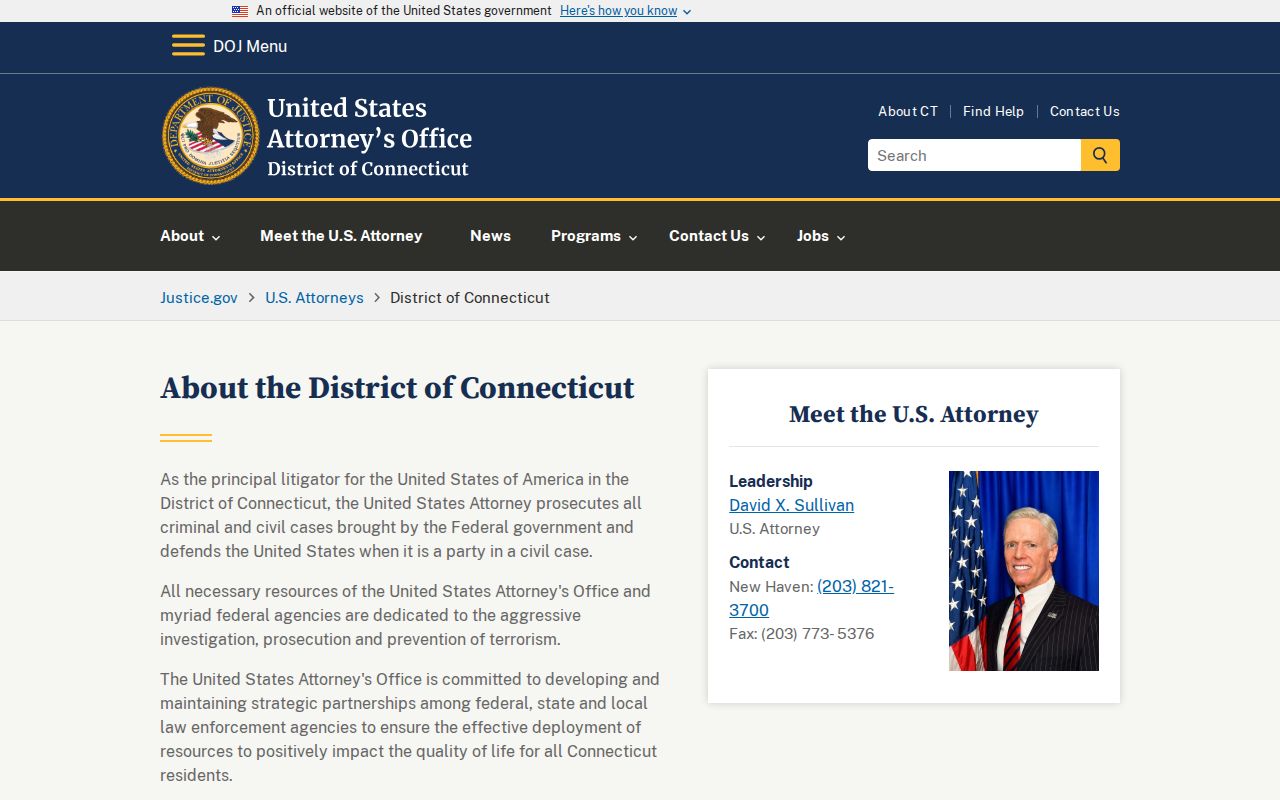
Use the state CRDockets system for Litchfield Superior Court criminal records and federal tools for federal dockets.